

Revnix

Why Revnix

Built for growth problems that cross teams, tools and channels.

Revnix works across growth execution, digital experience and the commercial infrastructure underneath them, in the cases where the result depends on how those parts behave together. Teams, specialists and platforms already doing their job stay where they are.

Vivid poster proofs, photographic contact sheets and a metal registration tool on a dark studio surface.
Acquisition has to create attention worth converting.
A cobalt booklet opens into coral, yellow and cyan stages of an enquiry journey.
The experience gives that attention a clear next step.
A transparent sorter routes colorful paper records into three metal follow-up trays.
Operations determine what happens after the form.

If all you need is one specialist, hire one.

A specialist is usually the better answer when

  • the problem sits inside one discipline and stays there,
  • the systems around it are already doing their job,
  • someone internally owns the outcome and the decisions,
  • and nothing has to be coordinated across teams or tools.

Revnix is not the right model for every brief. For a contained media problem in a business where everything either side of it works, a good specialist and a clear brief will be faster and cheaper.

What changes the answer is dependency.

Paid acquisition performs against the landing experience it sends people to.

That experience performs against how the enquiry itself is designed.

The enquiry performs against how the CRM assigns it and what happens next.

And reporting is only trustworthy if the source survived all of that.

By the time a business has read that list, the commercial result has four or five owners and no accountable view. That is the situation Revnix is built for, and it is the honest limit of the model too.

What changes when the same partner can see the whole path.

01

Commercial context survives execution.

Strategy is usually decided in one room and built in another. Whoever makes the implementation decisions inherits a task without the reasoning behind it, so the first awkward constraint gets resolved by convenience. Revnix keeps the people who scoped the work involved while it is built, which means the small decisions get made against the commercial objective rather than against the ticket.

02

Somebody owns the joins.

Acquisition can hit its numbers in the same month conversion fails, and every supplier involved can still have completed their scope. Nobody has misled anyone. The failure is in the space between two deliverables, and that space is usually unowned. Where scope requires it, Revnix owns the relationship between channel, experience, CRM, operations and measurement, so accountability does not stop at the edge of a deliverable.

See the work
03

The work can follow the problem.

A fixed service package pulls the diagnosis toward whatever the provider already sells. Revnix decides what needs to be owned first and defines scope after that. It is not unlimited scope: the capabilities assembled are the ones the commercial problem implicates, and the ones it does not are left out of the proposal.

What Revnix can own
04

What already works can stay.

New partners often replace things to establish control: the incumbent agency, the CRM, the process, the internal role. Revnix changes something when the change has a commercial case, and states the case. Your developer, your sales lead, your marketing manager and your current platforms can all remain exactly where they are.

Used campaign folders, journey sheets and system hardware converge around one cobalt master sheet.
Existing systems, connected deliberately.
05

Commercial and technical decisions get made in the same place.

Plenty of marketing firms understand acquisition but not the operational systems an enquiry lands in. Plenty of technical consultancies understand CRM and automation but do not own demand or conversion. Revnix sits across the commercial decision and the implementation underneath it, which is why a routing rule here is set by someone who knows what the enquiry cost to generate.

Five questions worth asking any growth partner.

Including this one. Take the questions to whoever else is on your shortlist and compare the answers.

The person who scoped it.

Revnix is senior-led and deliberately small. The person doing the commercial and systems thinking in the first conversation stays on the account and stays close to implementation. Media, development and data specialists come in where their depth is genuinely needed, working to the same brief. The account is not handed to a coordinator once it is signed.

How Revnix is built to deliver this

The scope moves, or we say so.

Where the outcome depends on an adjacent layer, Revnix can take that layer in. Where a specialist or an internal team already handles it well, they keep it and Revnix works alongside them. What should not happen is the adjacent issue being recorded as out of scope and quietly left in the gap between two reports.

What Revnix can own

Against a measure agreed before it starts.

The commercial objective is set first, then the measure and its exact definition, then the platform and CRM evidence read in that context. Where attribution cannot support a claim, the reporting says so instead of assigning the credit somewhere convenient. Perfect attribution is not on offer, and no serious partner should offer it.

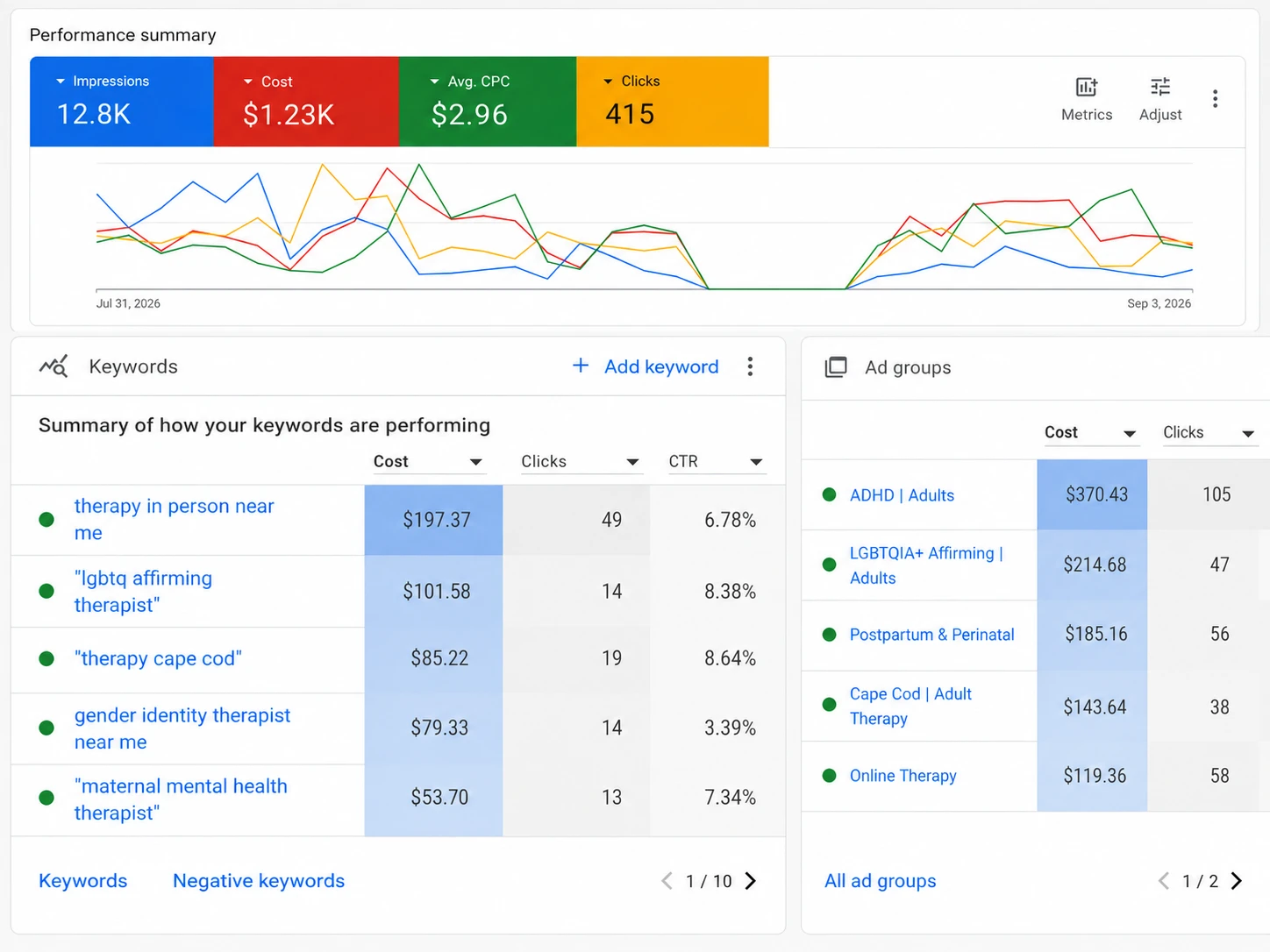
Search campaign performance and keyword table.
Search campaign and keyword reporting, 31 July–3 September 2026. Revnix client work.

Nothing by default.

Team, tooling, agencies and process stay unless keeping them is what is causing the problem. A migration is a decision with a business case attached and a cost you can see, never a condition of working together. Revnix would rather inherit a platform that works than own one it chose.

Yes, with the reasoning attached.

If the evidence suggests the request will not move the commercial result, Revnix says what it sees, why it disagrees and what it would do instead. Then the decision is yours. Where you still want the original brief, you get a note on what to watch and how quickly we would know.

Breadth is only useful when the depth behind it is real.

Revnix does not claim that one person executes paid media, front-end build and CRM architecture at expert depth. Two separate things are being described. Senior ownership of the commercial problem is continuous, and it is the same person from first conversation to implementation. Specialist depth is brought in where a discipline demands it, and it works to the commercial context rather than to an isolated brief.

That is the difference between working across functions and being a generalist.

Cobalt ink is pulled across a coral campaign print beside yellow and cyan proofs.
Create: earn qualified attention.
A cobalt paper path passes through colorful apertures and resolves into one clear response card.
Convert: remove friction from the next step.
Cobalt, coral, yellow and cyan cables are secured into one precise metal rail.
Operate: make the handoff reliable.

Three different disciplines. The same commercial context behind each decision.

What working with Revnix should feel like.

Used campaign folders, journey sheets and system hardware converge around one cobalt master sheet.
Working from the system already in place.

Communication

Issues are raised when they appear rather than in the monthly report, and decisions arrive with the reasoning that produced them. Anything with commercial consequence gets said directly, in the week it matters. There is no fixed meeting quota: contact happens at the point a decision is needed, and cadence is agreed at the start of the engagement.

Ownership

You talk to the person holding the commercial context. They coordinate any specialist work and remain accountable for the next decision. This is not a promise of constant availability. It is a clear answer to who is deciding, who is doing it, and who tells you when it changes.

Reporting

Reporting exists to answer the decision the business has to make next. Depth depends on the engagement and on what the systems can actually produce: acquisition and conversion, enquiry volume and response, pipeline or bookings where the CRM supports it, and operational measures where they matter more than channel figures. Where two systems cannot be reconciled, the report says which is which rather than averaging them into one confident number.

Documentation

Configurations, workflows, metric definitions and ownership are written down as the work is built, so your operating environment stays understandable by people other than Revnix. On technical work this is the difference between a system you own and a system you rent.

No surprises is treated as part of the deliverable.

Missing data, dependencies, delays and anything sitting outside scope get named early, while there is still time to decide something about them.

A specialist, an in-house hire, or Revnix.

Three genuinely different answers. Which one is right depends on where the problem sits and how permanent the capability needs to be, not on which of the three is in the room.

A specialist

Best when

The problem clearly belongs to one discipline, the systems around it work, internal ownership is strong, and deep execution is the only requirement.

Trade-off

Nobody owns what happens either side of their scope. Coordination stays your job, and so does noticing when the problem has moved.

Choose this if

You already know what needs doing, and who will join it up.

In-house

Best when

The work is continuous enough to justify a permanent role, the capability is part of daily operation, you can hire and manage specialist depth, and you want the knowledge to stay in the business.

Trade-off

Hiring takes months, and the range most growth problems need is rarely one role. Strategy, execution and systems in a single hire usually means one of the three is weak.

Choose this if

This capability is permanent core operation rather than a period of change. Revnix will say so when that is the honest answer.

Revnix

Best when

The result depends on several layers at once, more than one team or supplier owns part of it, both the commercial decision and the implementation are needed, existing teams need coordinating rather than replacing, and technical systems are affecting a commercial number.

Trade-off

Revnix is deliberately small and senior-led, so it takes a limited number of engagements at a time and is not a high-volume production supplier.

Choose this if

You need senior external ownership across the whole path rather than another supplier inside part of it.

Revnix is the wrong choice when

  • you need commodity production at volume, delivered to a fixed monthly output;
  • the task is narrow, isolated and better served by a specialist working to your brief;
  • there is no customer journey to work on yet, and the first job is the product or the proposition;
  • you want execution without being challenged on the direction;
  • the requirement is a large on-site delivery team.

The model only matters if the work supports it.

One engagement where acquisition, the enquiry experience and the operations underneath it were all in scope.

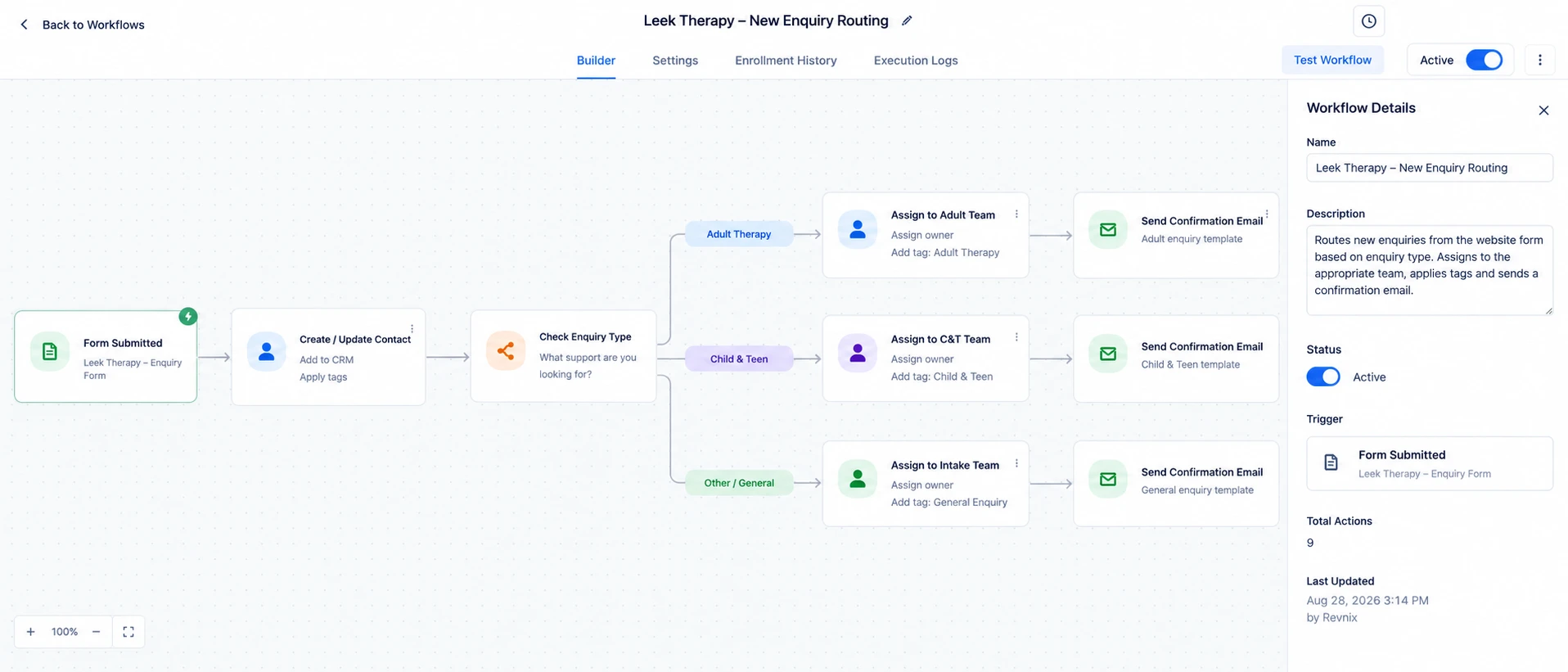
Enquiry routing workflow with branches for service, owner assignment and confirmation.
Leek Therapy — behavioral health practice. Revnix client work, Create · Convert · Operate. Routing gives the enquiry an owner and a next step.
Problem
Most new clients came from search, and enquiries landed in four places that were never designed to meet each other.
What Revnix owned
Search acquisition, the enquiry experience, and the CRM, routing and follow-up behind it. Same people across all three.
What changed
Every enquiry now arrives as a record with a source, an owner by rule, and a follow-up that is visible when it has not happened.
Evidence
Live account, workflow and CRM records, July to September 2026.

Standards you should expect, from anyone.

The commercial outcome is agreed before any channel metric is reported.

Otherwise the reporting drifts toward whatever looks best that month.

Systems that are working stay.

Change carries a commercial case, stated at the time, or it does not happen.

Evidence is labelled by what it proves.

Client work, prior professional experience and internal builds are held apart everywhere on this site.

Problems are raised before they become surprises.

Including the ones that came from a Revnix decision.

Think the problem crosses more than one layer?

Tell us what is happening commercially. You do not have to decide whether the answer is marketing, conversion or systems before the conversation.